
Massage built to fix the problem, not just feel good.
Most massage studios are built around relaxation. This is built around fixing the problem. I'm Dr. Birikov — ten years in practice, over 300 five-star Google reviews — and every session at Physica Medica is one-on-one with me, start to finish. No rotating staff. No guesswork. Just focused, clinical work on what's actually causing your pain.
What Makes This Different From a Spa Massage
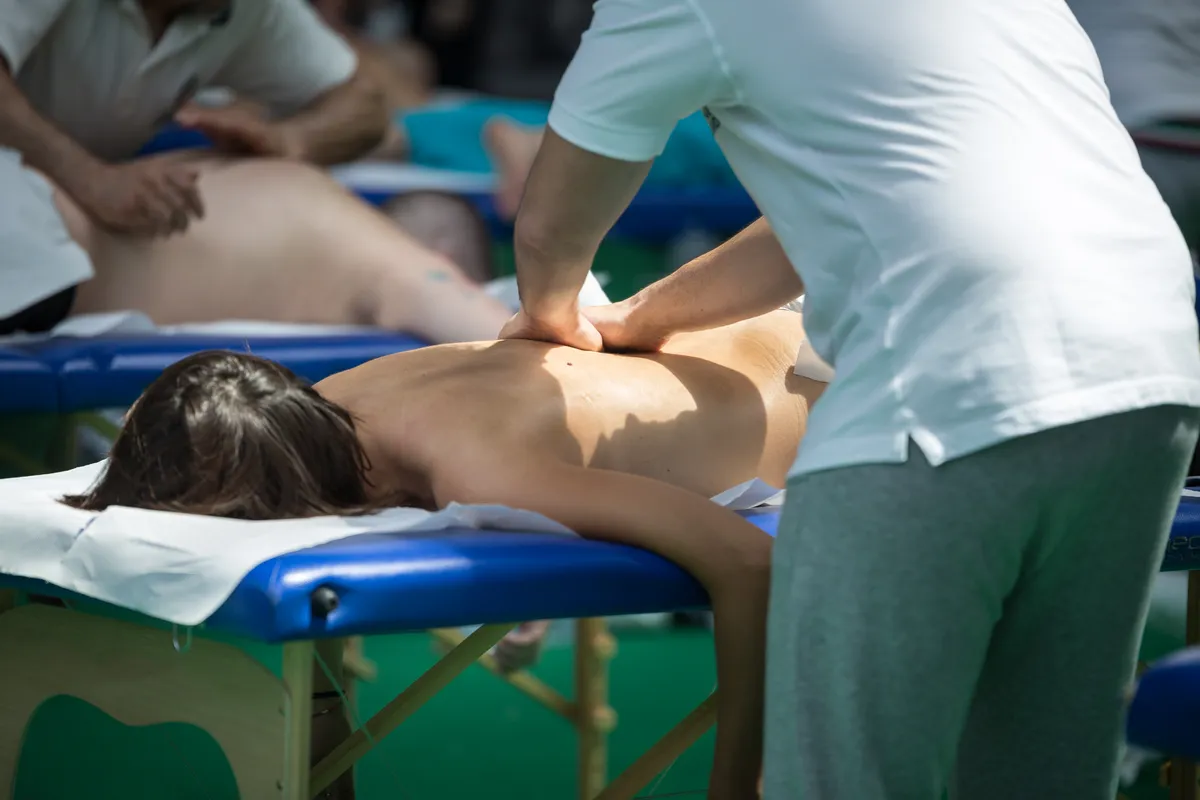
A spa massage is designed to help you relax. That's not a criticism — it's just not what I do. Deep tissue and sports massage, done clinically, is about finding the specific muscles, fascia, and movement restrictions that are generating your pain and working them out systematically. The pressure is purposeful. The sequence is intentional. I'm not following a routine; I'm responding to what your body is showing me.
The other difference is continuity. At a spa, you might see a different therapist every visit. Here, you see me every session. I know what your left hip did two weeks ago. I know what changed after we worked your thoracic spine. That kind of session-to-session tracking is what moves the needle from temporary relief to lasting results.
If the relief from massage has never lasted for you, that's usually why. One-off treatment without a clinical eye on the root cause feels good for a day or two and then resets. That's not a massage problem — it's a structure problem.
Who Benefits Most From Sports & Deep Tissue Work
Athletes who need more than recovery — runners dealing with IT band syndrome, swimmers with rotator cuff tightness, cyclists with hip flexor and lower back pain. People with chronic muscle knots that never fully release no matter how much they stretch. Anyone whose desk job has built years of tension into their neck, shoulders, and upper back. Post-surgical patients who are cleared for soft tissue work but still dealing with restricted movement and scar tissue.
And honestly? Anyone who has been told their pain is just stress or age. Tight fascia and restricted muscle tissue are physical problems with physical solutions. You don't have to accept chronic tension as your baseline.
What to Expect in Your Session
Every step is performed by me, personally
Assessment
Before I put hands on you, I watch how you move. I'm looking for where your range of motion breaks down, where compensation patterns have formed, and what tissues are actually driving the restriction. That assessment shapes everything that follows.
Hands-on treatment
Deep tissue work, sports massage, and — when appropriate — additional tools like a metal scraping instrument to break up scar tissue, suction cups to release fascial adhesions, or a needle inserted into the muscle to release a stubborn trigger point. These aren't upsells. They're part of the same session when your body calls for them.
Movement correction
Releasing a tight muscle only holds if we address why it got tight. I work movement correction into every session so the tissue we free up doesn't just lock back down by your next appointment.
Plan adjustment
Before you leave, I update your plan based on what I found that day. Because I see you every session, I track your progress accurately — not from a chart, but from direct observation.
Conditions We Commonly Address
Deep tissue and sports massage at Physica Medica isn't a standalone menu item — it's part of a clinical toolkit applied to real conditions. The work I do with my hands is the same work I apply across the full range of what I treat.
- IT band syndrome and knee pain in runners and cyclists
- Rotator cuff tightness and shoulder impingement
- Chronic lower back pain and sciatica
If your condition isn't listed here, call and ask. The one-on-one structure means I can apply focused attention to almost any musculoskeletal problem — I'm not limited to a pre-set protocol.
About the Cost — Upfront, No Surprises
This is a cash-pay practice. I don't bill insurance, because insurance billing dictates session length, treatment type, and frequency in ways that work against your results. What you pay for here is an experienced clinician's full, undivided attention — not a 20-minute handoff to an aide. Exact pricing is discussed on your first call so there are no surprises. See payment and insurance details →
Questions I Hear Before the First Session
| Physica Medica | Traditional PT Clinic | |
|---|---|---|
| Who treats you | Dr. Birikov, every session | Whoever is available that day |
| Hands-on time | The full session | ~10–15 minutes, often with an aide |
| The floor | Private treatment space | Shared gym floor, 3–4 patients at once |
| Your plan | Built and adjusted for your body | Standardized protocol sheet |
| Continuity | Same doctor tracks your progress | New therapist re-reads your chart |
Ready to Book? Here's How It Works
Call or text 443-228-8029. We'll talk through what's going on, what you've already tried, and whether this is the right fit. If it is, we'll get you scheduled at 800 S Bond St in Baltimore. First session, you're working directly with me.
Cash-pay practice. Pricing discussed on your first call. No insurance billing. No surprises.
What one-on-one care feels like
A selection from 300+ verified five-star reviews on Google.
[Real patient testimonial will be placed here — verified Google review snippet.]
[Real patient testimonial will be placed here — verified Google review snippet.]
[Real patient testimonial will be placed here — verified Google review snippet.]
Rated 5.0 stars across 300+ reviews on Google.
Questions I hear before the first session
Is deep tissue massage the same as sports massage? Close, but not identical. Deep tissue work focuses on releasing chronic muscle tension and fascial restriction — it goes layer by layer into the tissue. Sports massage is more specific to athletic performance and recovery: it accounts for the demands of your sport, the muscles you're loading hardest, and where breakdown typically occurs. In practice, I use both in the same session depending on what your body needs. The label matters less than the clinical intent behind the work.
How many sessions will I need before I feel a difference? Most people notice a real change within two to four sessions. How many total sessions you need depends on how long the problem has been there and how much tissue restriction has built up. I won't push you into a long treatment plan if your body responds quickly. I also won't tell you two sessions will fix a problem that's been building for three years. I give you an honest read after the first session.
Do you accept insurance for massage therapy? No. This is a cash-pay practice. Insurance rarely covers massage therapy, and when it does, it comes with restrictions that compromise the quality and continuity of care. Pricing is straightforward and discussed on your first call — no billing surprises, no claim denials after the fact.