
Metal tools. Real results. Not a gimmick.
IASTM lets me work at a precision and depth that hands alone can't reach — breaking down scar tissue and fascial adhesions that keep you stuck in the same pain cycle. Every session is one-on-one with me, Dr. Birikov, from start to finish.
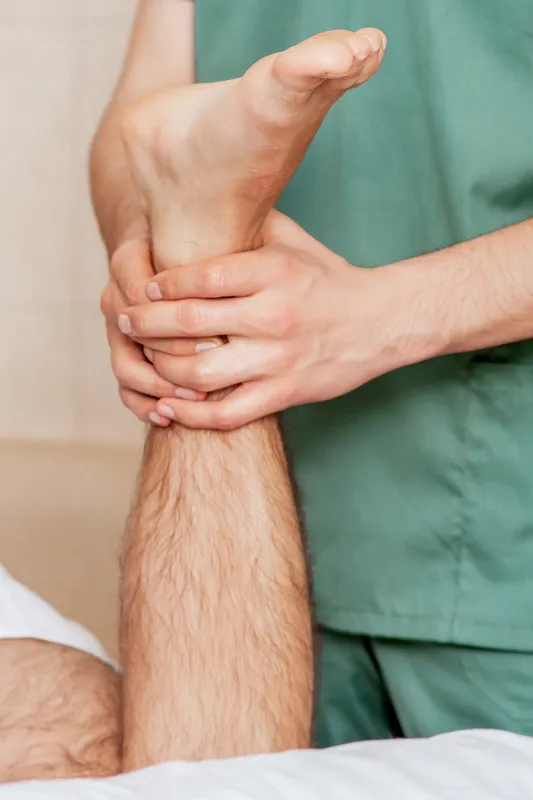
What Is IASTM (Instrument Assisted Soft Tissue Mobilization)?
IASTM uses specially shaped metal tools to detect and break down fascial adhesions, scar tissue, and restricted connective tissue. The instruments amplify what I feel through my hands, letting me locate dense, fibrotic tissue and apply targeted force exactly where it's needed — not just in the general area.
This isn't a massage upgrade. The tools create a controlled microtrauma in the affected tissue, which triggers your body's healing response. Blood flow increases. Fibroblasts activate. The tissue remodels. That's the mechanism — and it's backed by peer-reviewed research on soft tissue rehabilitation.
The tools aren't a gimmick. They let me work at a precision and depth that hands alone can't achieve. For chronic scar tissue, post-surgical restrictions, and stubborn fascial tightness, that depth is exactly what's been missing from prior treatment.
What Conditions Respond Best to IASTM
IASTM works well for conditions where restricted or fibrotic soft tissue is driving the problem. That includes IT band syndrome, plantar fasciitis, rotator cuff tendinopathy, Achilles tendinopathy, tennis elbow, post-surgical scar tissue, chronic neck and back tightness, and shin splints. If you've had the same injury for months and hands-on massage or stretching hasn't held, restricted tissue is often why.
It's also effective for athletes dealing with overuse injuries where the tissue has laid down scar tissue from repeated strain. The instrument work breaks that cycle so the tissue can actually recover instead of just getting temporarily loosened.
What a Session Looks Like
Every step is performed by me, personally
Assessment first
Before I pick up a tool, I assess how you're moving and where tissue restriction is actually limiting you. IASTM applied to the wrong area is wasted time. I find the source, not just the symptom.
Instrument work
I apply the metal tool to the skin using a lubricant and work systematically through the restricted tissue. You'll feel pressure and sometimes a scraping sensation. That's normal. I'm scanning for texture changes — the gritty, dense feeling of adhered tissue — and working through it.
Integration with movement
After instrument work, I pair it with movement. Mobilizing tissue and then loading it through the right range of motion accelerates how quickly the change holds. This is where IASTM at a physical therapy level differs from what you'd get at a spa.
Plan adjustment
I note what we found and how your tissue responded. That information shapes what we do next session. Because I'm the one treating you every time, nothing gets lost between visits.
IASTM vs. Graston Technique — What's the Difference?
Graston is a specific branded system of IASTM with its own tool set and certification. IASTM is the broader category — instrument assisted soft tissue mobilization — and there are several evidence-based approaches within it. I'm trained in instrument-assisted technique and apply it based on what your tissue needs, not on a brand protocol.
- Graston is one tool system. IASTM is the clinical approach. The outcome depends on the clinician's assessment skill, not the brand on the instrument.
- At many clinics, instrument work is delegated to an aide or added as a standalone modality. Here, I perform it as part of a full one-on-one evaluation and treatment session — integrated, not isolated.
- The difference in results often comes down to that: whether the person using the tool actually understands why they're using it on that specific spot, on that specific patient, that day.
If you've had Graston or IASTM before and didn't notice lasting change, the tool probably wasn't the problem. The context around it was.
Is IASTM Painful? What Patients Actually Experience
Honest answer: it can be uncomfortable during the session, and you may be sore for one to two days afterward. Some patients also see mild bruising or redness where the tool worked through dense tissue. That's not a sign something went wrong. It's a sign the tissue responded.
What the soreness actually means
| Physica Medica | Traditional PT Clinic | |
|---|---|---|
| Who treats you | Dr. Birikov, every session | Whoever is available that day |
| Hands-on time | The full session | ~10–15 minutes, often with an aide |
| The floor | Private treatment space | Shared gym floor, 3–4 patients at once |
| Your plan | Built and adjusted for your body | Standardized protocol sheet |
| Continuity | Same doctor tracks your progress | New therapist re-reads your chart |
How IASTM Fits Into Your Treatment Plan
IASTM is rarely the only thing I do in a session. For most patients, it's one tool within a treatment that also includes manual therapy, movement correction, and sometimes dry needling or cupping depending on what's driving the problem. The instrument work addresses the tissue restriction. The rest of the session addresses why that restriction developed and what keeps it from coming back.
See how IASTM compares to other soft tissue approaches →
What one-on-one care feels like
A selection from 300+ verified five-star reviews on Google.
[Real patient testimonial will be placed here — verified Google review snippet.]
[Real patient testimonial will be placed here — verified Google review snippet.]
[Real patient testimonial will be placed here — verified Google review snippet.]
Rated 5.0 stars across 300+ reviews on Google.
Questions I hear before the first session
Is IASTM the same as the Graston Technique? Graston is a branded version of IASTM — one specific tool system within a broader category of instrument-assisted soft tissue work. I'm trained in instrument-assisted technique and choose my approach based on your tissue, not on a brand name. The clinical mechanism is the same; the difference is whether the person holding the tool knows what they're looking for.
Does IASTM hurt, and will I be sore afterward? During the session you'll feel pressure and a scraping sensation — some areas are more sensitive than others, especially where tissue is most restricted. Post-treatment soreness lasting one to two days is common, and mild bruising or skin redness can occur. Both are normal responses that indicate the tissue is reacting. I'll tell you what to expect before we start.
How many IASTM sessions does it typically take to see results? Most patients notice a change within two to four sessions, though chronic or post-surgical restrictions may take longer. I won't give you a number on the first call without knowing your history. What I can tell you is that because I'm the one treating you every session, I'm tracking your response closely and adjusting as we go — not running you through a fixed program.